Service
Forging Services
Esco Precision supplies custom forged components — shaped under compressive force for superior grain flow and strength — and finish-machines them in-house to your print tolerances.
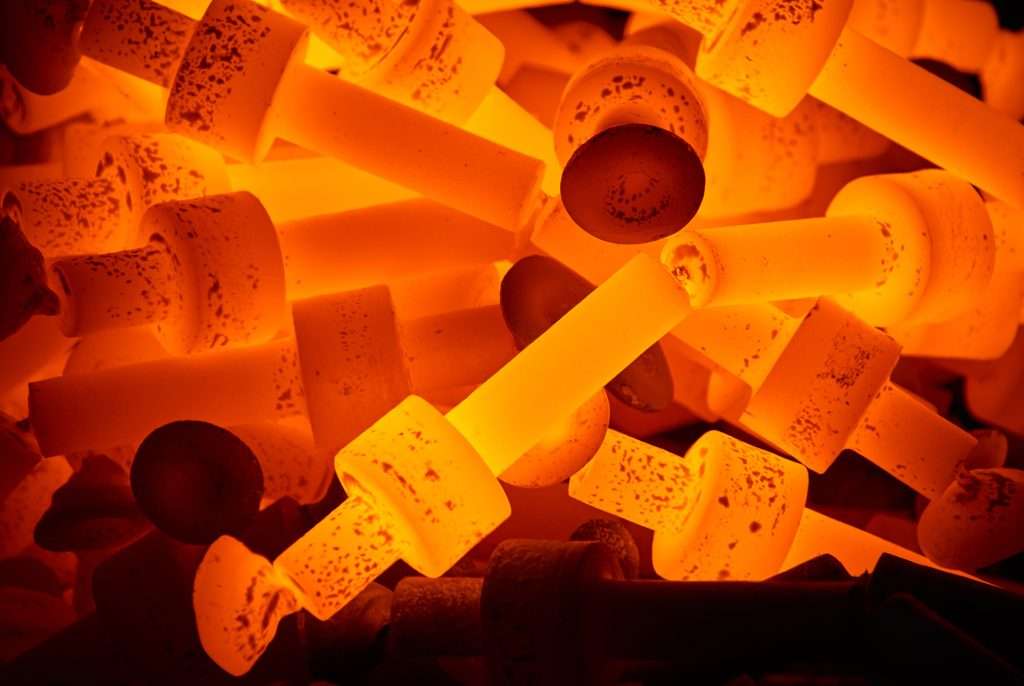
Forging shapes metal with compressive force rather than by cutting or casting, aligning the material’s grain structure to the part geometry. The result is a component with excellent strength, toughness, and fatigue resistance — the reason forgings are specified for highly loaded and safety-critical parts in aerospace, automotive, and industrial equipment. Forging also produces a dense, void-free structure that outperforms castings in demanding service.
We support both open-die and closed-die (impression-die) forging depending on geometry and volume, then bring the forged blanks in-house for precision CNC machining to final tolerances. This forge-plus-machine integration means you get a finished, inspected component from one supplier rather than coordinating a forge house and a separate machine shop.
Forgings are produced in carbon and alloy steels, stainless, aluminum, titanium, and other alloys, with heat treatment specified to reach the required mechanical properties. Material certifications and inspection documentation are provided under our ISO 9001:2015 quality system.
From near-net forged blanks that reduce machining time to fully finished high-strength components, Esco manages the process from forging through final inspection.
Common applications
- Highly loaded structural components
- Shafts, hubs, and flanges
- Aerospace and defense fittings
- Automotive drivetrain parts
- Valve and pump bodies
- Safety-critical hardware
Frequently asked questions
Why choose a forging over a casting or machined billet?
Forging aligns the metal’s grain flow to the part shape and produces a dense, void-free structure, giving superior strength, toughness, and fatigue resistance. That is why forgings are specified for highly loaded and safety-critical components.
Do you machine the forgings to final tolerance?
Yes. We bring forged blanks in-house for precision CNC machining to your print, so you receive a finished, inspected component from a single supplier rather than coordinating a forge and a separate machine shop.
What is the difference between open-die and closed-die forging?
Open-die forging shapes metal between flat or simple dies and suits larger, simpler geometries and lower volumes. Closed-die (impression-die) forging squeezes material into a shaped die cavity for more complex, repeatable net shapes at higher volume.
Which materials can you forge?
Carbon and alloy steels, stainless, aluminum, titanium, brass and copper alloys, and nickel-based alloys, with heat treatment specified to reach the required mechanical properties.
Related services
CNC Milling
3-, 4-, and 5-axis CNC milling of tight-tolerance metal and plastic parts, from prototypes to production volumes.
CNC Turning
CNC lathe turning with live tooling for round and prismatic parts — shafts, bushings, fittings, and pins to tight concentricity.
Wire & Sinker EDM
Wire and sinker (ram) EDM for hardened and exotic materials — sharp internal corners, fine detail, and burr-free precision.
Need forging for your next project?
Send your drawings and get a detailed quote back within 24 hours.